
AKC Official Breed Standard
Labrador Retriever
Presented with pride by EverOak Labradors & Sussex Spaniels
General Appearance
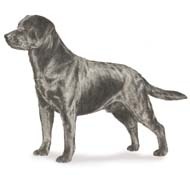
The Labrador Retriever is a strongly built, medium-sized, short-coupled, dog possessing a sound, athletic, well-balanced conformation that enables it to function as a retrieving gun dog; the substance and soundness to hunt waterfowl or upland game for long hours under difficult conditions; the character and quality to win in the show ring; and the temperament to be a family companion. Physical features and mental characteristics should denote a dog bred to perform as an efficient Retriever of game with a stable temperament suitable for a variety of pursuits beyond the hunting environment.
The most distinguishing characteristics of the Labrador Retriever are its short, dense, weather resistant coat; an "otter" tail; a clean-cut head with broad back skull and moderate stop; powerful jaws; and its "kind," friendly eyes, expressing character, intelligence and good temperament.
Above all, a Labrador Retriever must be well balanced, enabling it to move in the show ring or work in the field with little or no effort. The typical Labrador possesses style and quality without over refinement, and substance without lumber or cloddiness. The Labrador is bred primarily as a working gun dog; structure and soundness are of great importance.
Size, Proportion and Substance
Size – The height at the withers for a dog is 22½ to 24½ inches; for a bitch is 21½ to 23½ inches. Any variance greater than ½ inch above or below these heights is a disqualification. Approximate weight in working condition: dogs 65 to 80 pounds; bitches 55 to 70 pounds.
The minimum height ranges do not apply to dogs or bitches under twelve months of age.
Proportion – Short-coupled; length from the point of shoulder to point of rump equal to or slightly longer than distance from withers to ground. Distance from elbow to ground equals one half the height at withers. Brisket extends to elbows, but not perceptibly deeper. Body of sufficient length for a straight, free, efficient stride; never low and long or tall and leggy.
Substance – Bone and substance proportionate to the overall dog. Light, weedy individuals incorrect; equally objectionable are cloddy, lumbering specimens. Labradors shown in working condition, well-muscled, without excess fat.
Head
Skull – Wide and well developed without exaggeration. Skull and foreface on parallel planes, approximately equal length. Moderate stop; brow slightly pronounced. Clean-cut head free from fleshy cheeks; bony structure chiseled beneath the eye. Occiput not conspicuous in mature dogs. Lips fall in a curve toward throat. Wedge-shaped or overly narrow heads incorrect; massive, cheeky heads incorrect. Jaws powerful; muzzle neither long and narrow nor short and stubby.
Nose – Wide with well-developed nostrils. Black on black or yellow dogs; brown on chocolates. Fading not a fault. Thoroughly pink nose or one lacking pigment is a disqualification.
Teeth – Strong and regular with scissors bite preferred. Level bite acceptable but not desirable. Undershot, overshot, misaligned teeth are serious faults. Full dentition preferred; missing molars or premolars serious faults.
Ears – Hang moderately close, set rather far back and somewhat low; slightly above eye level. Proportionate to skull.
Eyes – Kind, friendly expression; medium size, set well apart, neither protruding nor deep set. Brown in black and yellow Labradors; brown or hazel in chocolates. Black or yellow eyes undesirable. Eye rims black in black and yellow; brown in chocolates. Eye rims without pigment a disqualification.
Neck, Topline and Body
Neck – Proper length for retrieving; muscular, free from throatiness; rises strongly from shoulders with moderate arch. Short thick or ewe neck incorrect.
Topline – Strong and level from withers to croup when standing or moving. Loin shows flexibility.
Body – Short-coupled; good spring of ribs tapering to moderately wide chest. Not narrow nor bulldog-like front. Chest breadth balanced for stamina and movement. Not slab-sided nor barrel-chested. Underline nearly straight; loins short, wide, strong; well-developed hindquarters.
Tail – Very thick at base, tapering toward tip; medium length to hock. Free from feathering; clothed thickly with short dense coat forming the characteristic “otter” tail. Follows topline; may be carried gaily but not curled over back. Extremely short or long thin tails serious faults. Docking or altering natural carriage is a disqualification.
Forequarters
Muscular, well coordinated, balanced with hindquarters.
Shoulders – Well laid-back, long, sloping; approximately 90-degree angle with upper arm. Length of shoulder blade equal to upper arm. Straight shoulders or restricted movement incorrect.
Front Legs – Straight with strong bone. Elbows directly under withers; close to ribs. Tied-in or out elbows serious faults. Pasterns strong, short, slightly sloped.
Feet – Strong, compact, well-arched toes; well-developed pads. Dewclaws may be removed. Splayed, hare feet, knuckling, turning in or out are serious faults.
Hindquarters
Broad, muscular, well-developed from hip to hock. Viewed from rear, straight and parallel. Angulation balanced with front. Strong stifle; no patella slippage. Hocks strong, well let down; no slipping or hyperextension. Standing rear toes slightly behind point of rump. Over-angulation incorrect.
Feet strong and compact. Cow-hocks, sickle hocks, over-angulation serious faults.
Coat
Short, straight, very dense; fairly hard to the hand. Soft, weather-resistant undercoat. Slight wave permissible. Woolly, silky, or sparse slick coats severely penalized.
Color
Black, yellow, and chocolate only. Any other color or combination is a disqualification. Small white spot on chest permissible but not desirable.
Black – All black. Brindle or tan markings disqualification.
Yellow – Fox-red to light cream with shading.
Chocolate – Light to dark chocolate. Brindle or tan markings disqualification.
Movement
Free and effortless. Front legs move straight without elbows out; no pacing or weaving. Rear legs parallel; hocks flex well showing power and strength. Viewed from side, shoulders free; foreleg reaches forward close to ground. Short, choppy movement, paddling, weaving, crossing over, high knee action serious faults.
Temperament
True Labrador temperament is as much a hallmark as the “otter” tail. Kindly, outgoing, tractable; eager to please; non-aggressive toward man or animal. Aggressiveness or shyness severely penalized.
Disqualifications
- Any deviation from height prescribed.
- Thoroughly pink nose or lacking pigment.
- Eye rims without pigment.
- Docking or altering length or natural carriage of tail.
- Any color other than black, yellow, or chocolate.
Official AKC Standard
www.akc.org
EverOak Labradors & Sussex Spaniels
Rooted in Faith • Committed for a Lifetime